
Bitcoin Tech Talk #496
Interesting Stuff

Carmelite Monks of Wyoming - Arena Magazine has this feature on these monks who continue to build a gorgeous Gothic monastery in the middle of Wyoming. The story is not just fascinating because of what they’ve built but how they managed to do it. These monks had no experience with any of the tools that they eventually ended up using and essentially learned as they went. They also didn’t have much funding and still sell coffee to fund their enormous cathedral. For me, this is what real building looks like, where innovation meets transcendence to create something not just functional, but beautiful, and interestingly done with a much cheaper budget than anyone could have imagined.
Feminization of the Internet - Freya India writes about how the internet in general, and social media in particular has deeply feminized society. Her insight in this article is that social media isn’t just feminine, it incentivizes the behavior of insecure junior high school girls. The main reason for this is that there are no physical confrontations on the internet, so the default mode of internet fighting is one that characterizes junior high school girl fighting: passive-aggression and reputation destruction. We would all be better served with more in-person events, which unfortunately are still on the down-swing.
Vetocracy - John Hamilton introduces the very useful concept of a vetocracy, which is where many groups have the ability to veto certain changes. The more entrenched and stagnant a place is, the easier it is for various entities to veto any proposed changes. Such structures serve to preserve whatever power and money the entrenched organizations have, and despite their “progressive” reputation, the places that are the most “vetocratic” are places like Massachusetts, New York and California. As I’ve argued many times, the labels liberal and conservative are actually exactly the opposite of their meanings, and this is an excellent illustration of that.
Game Theory - ixcarus has this primer on practical game theory and why mass change is so difficult. The post introduces a lot of game theory in practical examples and goes through why people act selfishly or irrationally by not cooperating even when they are worse off when they don’t. The most important concept is that of zero-sum versus positive sum. Zero-sum games have competitive incentives and result in anti-social behavior whereas positive sum games have cooperative incentives and result in pro-social behavior. If I could sum up the ills of fiat money in one sentence, it would be that fiat money turns positive sum games into zero-sum ones.
ActBlue - Doug Ross exposes some serious violations in political donations, showing how the supposedly grass-roots organization ActBlue likely used many fake accounts to donate millions to various campaigns, sometimes from foreign governments. Such corruption is inevitable when the prize of getting access to the ultimate money printer is at stake. You should expect people to lie, cheat and steal for a chance at making 100x what they invest in such campaigns. The solution isn’t jail time and censure, though, of course, those should be pursued. The solution is to not have such a thing available to be used for any purpose in the first place.
What I'm up to

The Third Way - Here is my presentation at BitBlockBoom this past week, arguing for a third implementation as a way to get out of the nasty political dynamic that we’ve gotten into in the Bitcoin community. We had a node implementation monopoly until recently and a duopoly with Knots now. Neither make for great dynamics and it’s only with three or more implementations that we can get to a place where users get enough of a say through feedback loops that developers will respond to.
Bitcoin and Virtue - I gave this talk at the Thank God for Bitcoin conference held a day before BitBlockBoom which is about how virtue is the Aristotelian mean between two vices at the extremes. It’s a talk I have given before and since the audio is bad and the projector didn’t work, you might want to click over. But I did cater it a bit more to the Christian audience to explain how this framework can be useful for other aspects of life.
Roxum TV - I was on this channel to talk about various news items this week, including quantum computing, North Korea, Production Ready and even the hack I had a month ago.
Nostr Note of the Week

What I’m Promoting
Bitcoin

Quantum Safe Bitcoin With No Fork - This proposes quantum-resistant Bitcoin transactions using existing consensus rules with no soft fork required, replacing elliptic curve security with a hash-to-signature puzzle based on RIPEMD-160 pre-image resistance. It operates entirely within legacy script limits (201 opcodes, 10,000 bytes) using standard P2SH. Demonstrated feasibility at $75-$150 in cloud GPU compute, which is pretty expensive, but should reduce over time if this were really needed.
Fuzzamoto - Brink documents how non-determinism in fuzzing degrades bug-finding efficiency. Three culprits were identified: time-dependent code, random number generation, and global state accumulation. Uses Nyx's copy-on-write snapshot mechanism to eliminate state accumulation, finding bugs that were previously hidden. Fuzz testing is one of those things that looks magical, but it does require a good deal of understanding to set up properly.
Formal Proof of secp256k1 - The library that does the elliptic curve operation is used all over the place, but it has never had a formal proof of its correctness… Until now. This only covers the scalar multiplication, but it’s impressive, given that the number of cases it covers is way larger than the number of atoms in the Milky Way. The researcher’s hope is to formally prove Schnorr signature correctness.
Bitshala 2026 Learning Cohorts - Free, structured study cohorts taking students from reading about Bitcoin to building it, spanning beginner through advanced protocol development levels. Five programs requiring 10-20 hours weekly over 6-8 weeks, with live sessions, assignments, and TA support. Graduates advance into Fellowship programs working on real open-source Bitcoin projects with mentorship, or direct hiring by Bitcoin companies.
Lightning

LaChispa PoS- Flutter-based point-of-sale app enabling Lightning payments via LNBits wallets, now with NFC card reading alongside QR-based invoices. Supports real-time exchange rates across 10+ currencies including CUP, MLC, USD, EUR, and SATs via Yadio.io, making it practical for merchants in multiple countries. Role-based access distinguishes employees from managers, with persistent transaction management that recovers pending sales if the app closes.
SateNet - This is a low-cost wireless internet service for underserved communities using satellite connectivity, with users paying for access in satoshis via Lightning. Each site serves 500-900 daily users, targeting the 3 billion people still without affordable internet access. Revenue from usage funds operations and reinvestment, while mining proceeds strengthen Bitcoin network security and support long-term site sustainability.
Orchard - Web application for managing Cashu mints, Bitcoin Core, Lightning via LND or CLN, and Taproot Assets from a unified interface. Integrates Ollama for local AI capabilities to assist with node management decisions. Supports multiple deployment paths including Docker containers, with both SQLite and PostgreSQL backends.
Economics, Engineering, Etc.

France Withdraws Gold - France relocated all 2,437 tonnes of gold from Federal Reserve vaults to Paris between July 2025 and January 2026, generating EUR 12.8 billion profit. The operation concluded weeks before US-Israel strikes on Iran. Physical gold possession is really popular these days and it shows some degradation of the dollar hegemony which began with the sanctions on Russia at the beginning of the Ukraine conflict. It really seems like the world is getting ready for a different settlement currency soon.
Bitcoin Is For Criminals - This site reframes the Bitcoin is for criminals narrative by cataloging dissidents, activists, and human rights defenders who use Bitcoin to resist authoritarian regimes, including Navalny, Assange, and Snowden. It draws historical parallels to MLK, Mandela, and Harriet Tubman, arguing they would have used Bitcoin to fund resistance movements. Countries that have banned Bitcoin see paradoxically high adoption rates, proving demand correlates with financial oppression.
Iran's Complicated Relationship With Bitcoin - Iran implemented a Bitcoin toll system for oil tankers at $1 per barrel through the Strait of Hormuz, and the government controls over 50% of the nation's mining footprint despite officially allowing only 5 MW of registered mining. Illegal mining operations consume approximately 2 GW of power and at least 1,100 cryptocurrency nodes continued operating during nationwide blackouts, suggesting military-grade infrastructure. Bitcoin serves as a lifeline for ordinary Iranians facing 90% Rial inflation since 2018 and Western sanctions cutting them off from the global financial system.
Quick Hits
Bitcoin at Night - Bitcoin exhibits the same overnight effect as stocks, with prices appreciating when US markets are closed.
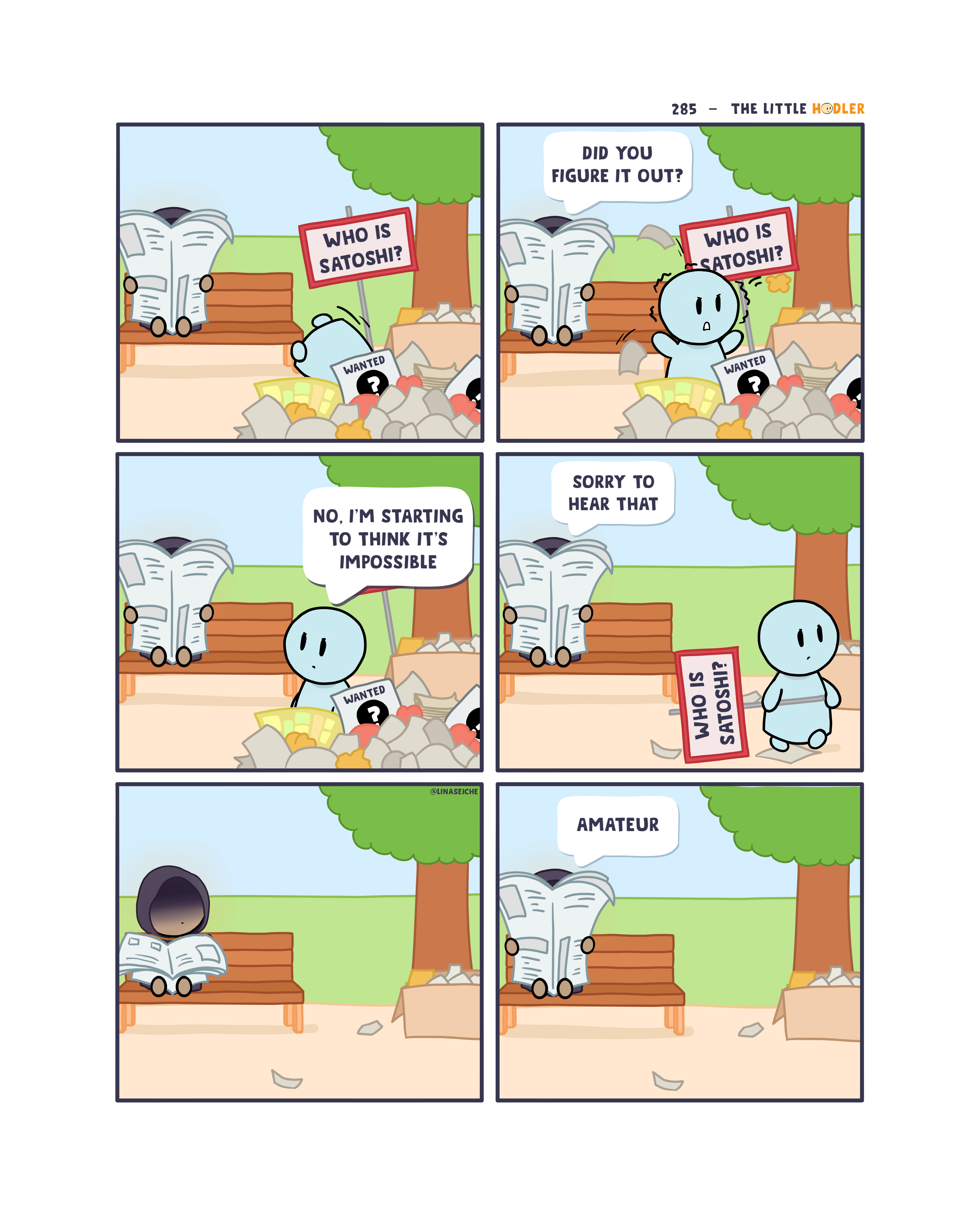
Satoshi/Adam Back - John Carreyrou's NYT “investigation” connects Adam Back to Satoshi through stylometric analysis, timeline parallels, and Back's involvement in a Bitcoin treasury company going public.
Bitcoin Timber - Six Antminer S19 Pros powered by waste biomass and solar energy powers miners whose heat then dries premium lumber.
Wrench Attack Crime Ring - Criminals use delivery service impersonation to access homes, ordering fake food deliveries beforehand to establish legitimacy at victims' doors.
Fiat delenda est.